
Generating car buyer leads in Miami takes more than increasing website traffic or running another generic vehicle ad. Miami shoppers can move quickly between dealership websites, inventory listings, search results, social media, and third-party marketplaces before deciding where to inquire.
The opportunity for dealerships is to make those high-intent moments easier to recognize and convert. That means focusing less on raw lead volume and more on helping serious shoppers find the right vehicle, get the information they need, and take the next step without unnecessary friction.
Dealerships in Miami are competing for shoppers across organic search, Google Ads, social platforms, map results, automotive marketplaces, and manufacturer websites. The competition becomes even stronger when several dealerships carry similar makes, models, and price ranges. A shopper searching for a specific SUV, truck, or used vehicle can compare multiple dealerships within minutes. If one website makes inventory difficult to find, hides important information, or makes contacting the dealership complicated, moving to another option is easy. That makes convenience and relevance important parts of lead generation.
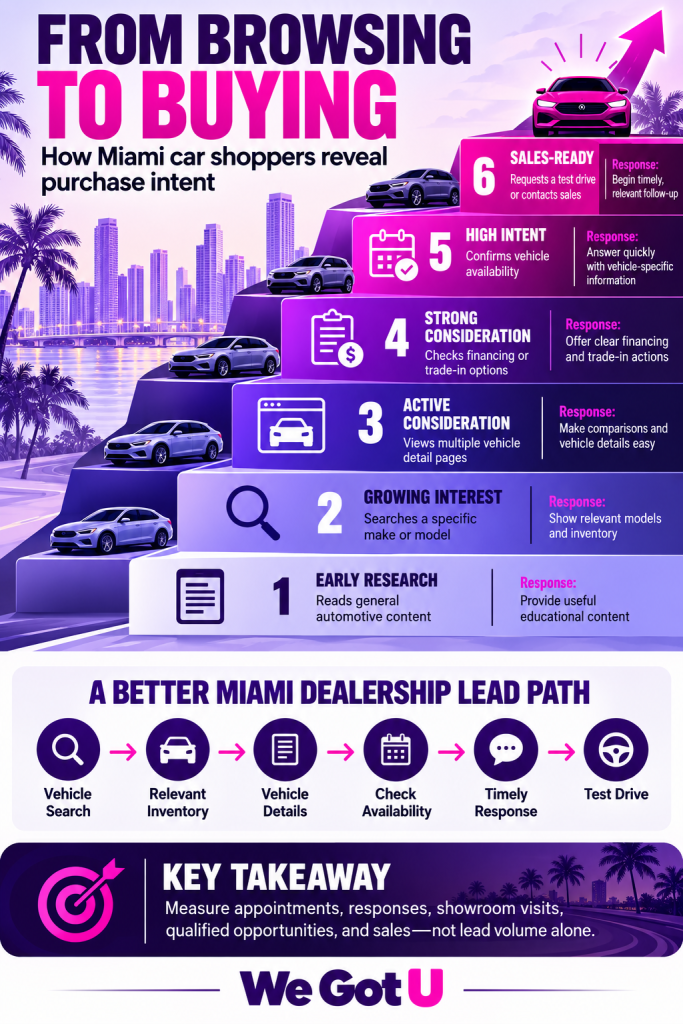
Not every website visitor represents the same opportunity. A shopper reading a general automotive article may still be researching, while someone checking inventory availability or financing options is showing much stronger purchase intent.
Buyer Action | Likely Intent |
Reading general automotive content | Early research |
Searching a specific make or model | Growing interest |
Viewing multiple vehicle detail pages | Active consideration |
Checking financing or trade-in options | Strong consideration |
Confirming availability | High intent |
Requesting a test drive or contacting sales | Sales-ready |
Dealerships can use these behaviors to decide where their marketing should place the strongest calls to action.
For many Miami car shoppers, the vehicle itself is the starting point. Someone searching for a specific model should be able to reach relevant inventory without navigating through several unrelated pages. Vehicle detail pages should then answer the questions that naturally come next. Useful information can include:
Calls to action should also reflect the shopper’s intent. Check Availability, Schedule a Test Drive, and Value Your Trade can be more meaningful on an inventory page than a generic Learn More button.
Miami shoppers frequently use location-based searches when they are getting closer to a purchase. Searches involving phrases such as:
can connect dealerships with people already looking for inventory or a place to buy.
Strong local visibility depends on more than inserting “Miami” onto every page. Dealerships should make sure vehicle, category, financing, and dealership pages clearly explain what they offer and where they serve customers. Google Business Profile information, consistent dealership details, customer feedback, and locally relevant website content can also support visibility when shoppers compare nearby dealerships.
Broad dealership advertising has a place, but shoppers often search with something much more specific in mind.
Instead of promoting only the dealership name, campaigns can be organized around:
This creates a closer connection between what the customer searched for and what they see after clicking.
A shopper searching for a specific model should ideally land on relevant inventory or information about that vehicle rather than the dealership homepage.
That small difference can remove an unnecessary step from the buying journey.
Car shopping rarely happens on only one device.
A buyer may first search from a phone, return later on a laptop, and contact the dealership after seeing the vehicle again on social media.
Mobile visitors therefore need quick access to the actions that matter most.
Forms should be short enough to complete comfortably. Phone numbers should be easy to use. Inventory filters should work without excessive scrolling, and vehicle pages should load quickly enough that shoppers can compare options without frustration.
A strong campaign can still lose potential leads if the website creates friction after the click.
Lead generation does not stop when a form is submitted.
If someone asks whether a specific vehicle is available, the response should address that vehicle. If the shopper requests information about financing, the follow-up should not begin with an unrelated sales pitch.
Context makes outreach more useful.
A practical handoff might look like:
Shopper views vehicle → Checks availability → Submits inquiry → Sales receives vehicle and source information → Relevant follow-up begins
The more information sales has about what created the inquiry, the easier it becomes to continue the conversation naturally.
A dealership can increase form submissions without improving actual sales opportunities.
That is why campaigns for car buyer leads in Miami should be evaluated beyond the number of leads generated.
Look at what happens afterward:
Did the shopper respond?
Did they schedule a test drive?
Did they visit the dealership?
Did the lead match available inventory?
Did the conversation turn into a real sales opportunity?
Marketing becomes more valuable when lead data is connected to what happens further down the funnel.
A campaign generating fewer but more serious buyers may ultimately contribute more than one producing a large number of low-intent inquiries.
A strong customer journey does not need to be complicated.
For example:
Search for a vehicle in Miami → Relevant inventory page → View vehicle details → Check availability → Receive timely response → Schedule showroom visit or test drive
Each step answers the next question the shopper is likely to have.
That is what makes the path effective. Instead of asking visitors to figure out where to go next, the dealership creates a natural progression toward a sales conversation.


